By Eduardo Baptista
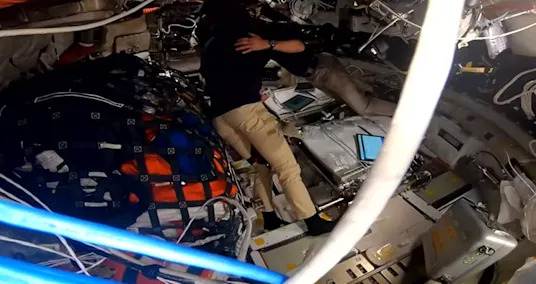
BEIJING (Reuters) -A trio of Chinese astronauts returned to Earth on Friday after getting stuck on China's space station for more than a week due to their spacecraft sustaining debris damage, leaving China without an immediate way of bringing home the new crew in an emergency.
Here is what has happened and why it is important.
WHAT HAPPENED TO THE SHENZHOU-20 SPACECRAFT?
The Shenzhou-20 vessel was left at the space station after China Manned Space Agency decided that a window crack was enough to make it unfit to fly.
The Shenzhou-20 crew - Chen Dong, Chen Zhongrui and Wang Jie - came home in the Shenzhou-21, which had been due to return to Earth in six months' time.
Two weeks ago, the Shenzhou-21 transported the three astronauts taking over from the Shenzhou-20 crew at the permanently inhabited space station known as Tiangong, or "Heavenly Palace".
WHAT RISKS DO THE SHENZHOU-21 CREW FACE?
Tiangong is facing the unprecedented situation of having no working spacecraft to bring the Shenzhou-21 crew back to Earth in the event of an emergency.
Among the trio currently stuck in Tiangong is 32-year-old Wu Fei, China's youngest astronaut to be sent to space.
China's space authorities and state media have so far remained silent on the vulnerability of Tiangong and its inhabitants. State broadcaster CCTV on Friday focused instead on minute-by-minute descriptions of the Shenzhou-21 spacecraft's journey to Earth.
State news agency Xinhua said the return of the Shenzhou-20 crew "marked the first successful implementation of an alternative return procedure in the country's space station program history", and that the trio had set a new record for the longest in-orbit stay among Chinese astronaut crews.
HOW CAN CHINA HELP THE SHENZHOU-21 CREW?
CMSA said on Friday that the Shenzhou-22 spacecraft would be sent at an appropriate time in the future.
The premature deployment of Shenzhou-22, originally scheduled for launch next April, could be based on the experience of Russia's Soyuz programme. The design of Shenzhou vessels is based on the Soyuz spacecraft.
In December 2022, a micrometeoroid particle struck the radiator of the thermal control system on Soyuz MS-22 while aboard the International Space Station, the 25-year-old science lab led by the U.S. and Russia.
Due to the risk of overheating, Russia's space agency decided to send Soyuz MS-23 to the ISS to bring back the crew of the slightly damaged vessel.
Igor Marinin, a member of the Russian Academy of Cosmonautics, said it was likely Chinese specialists would have studied the "non-standard situations" experienced by Russian crews.
CAN CHINA REMOVE THE DAMAGED SPACECRAFT FROM TIANGONG?
China's Shenzhou missions have been sending trios of astronauts to Tiangong for six-month stays since 2021. This marks the first time a Shenzhou vessel has been left behind in space while its crew returns to Earth.
The debris-hit Shenzhou-20 spacecraft needs to be fixed in orbit before being sent back or removed outright. Failure to do so would make future missions impossible as Tiangong needs to have a vacant port free at all times for newly arrived Shenzhou vessels to dock.
Russian space expert Marinin said that if damage to the Shenzhou-20 was significant, a possible scenario is that the vessel would be undocked from the Tiangong station and deorbited over the Pacific Ocean.
(Reporting by Eduardo Baptista and Maxim Shemetov in Beijing; Editing by Alison Williams)
LATEST POSTS




 Moon memorial: Artemis 2 astronauts name lunar 'bright spot' after mission commander's late wife
- Most loved Well known Accessory Styles For 2024
- Sought-After Extravagance Ocean side Objections for a Lovely Escape
- Netflix's Eddie Murphy documentary explains 'Saturday Night Live' beef: 'That's why I didn't go back for years'
- The Delight of Camper Vans: Choosing the One That Meets Your Requirements
- How food assistance programs can feed families and nourish their dignity
- Greece eyes migrant repatriation centres outside the EU
- 6 Well known Nissan Vehicles in the U.S.
- Tributes pour in for James Ransone, 'The Wire' actor who died at 46